Before the EMC lab: pre-compliance testing at your own bench
A day at an accredited EMC lab is a serious line item for a small R&D budget — and every failed test means buying that day again. The most valuable lesson I learned while developing industrial PLCs and I/O modules is simple: if the first time your device sees an EMC test is at the lab, you are already set up to lose.
This post summarizes the pre-compliance checks you can run at your own bench before booking the accredited test, and the spots where designs most often fail.
What can you catch at the bench?
Nothing replaces an accredited measurement, but most emission problems become visible with modest equipment:
- Near-field probe + spectrum analyzer — shows you within minutes which part of the board is radiating. Clock oscillators, SMPS switching nodes and high di/dt loops are the first places to look.
- Line Impedance Stabilization Network (LISN) — essential for measuring conducted emissions. Even a second-hand LISN dramatically reduces surprises on test day.
- EFT/burst and ESD simulators — the two immunity tests that kill the most devices. An MCU that resets or a communication link that locks up will show itself here, long before the lab does it for you.
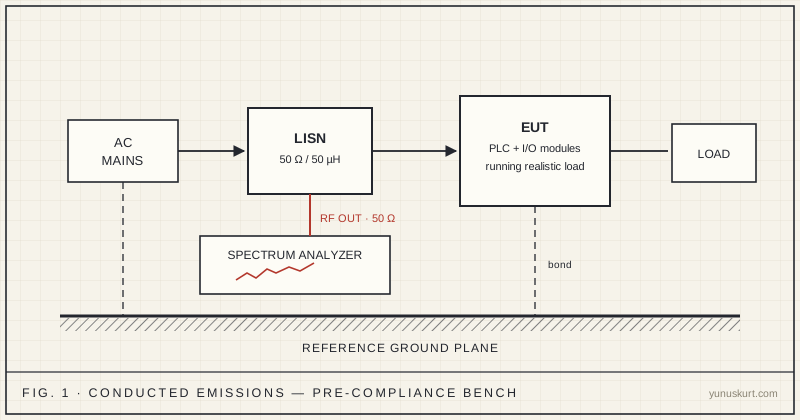 Figure 1 — A minimal conducted-emissions bench. The LISN sits between mains and the DUT; the analyzer listens on its RF port.
The three classic failure points
1. Clock harmonics. An innocent 25 MHz crystal can poke above the limit at its 7th harmonic (175 MHz). A spread-spectrum capable oscillator and a properly chosen series termination resistor solve most of these cases.
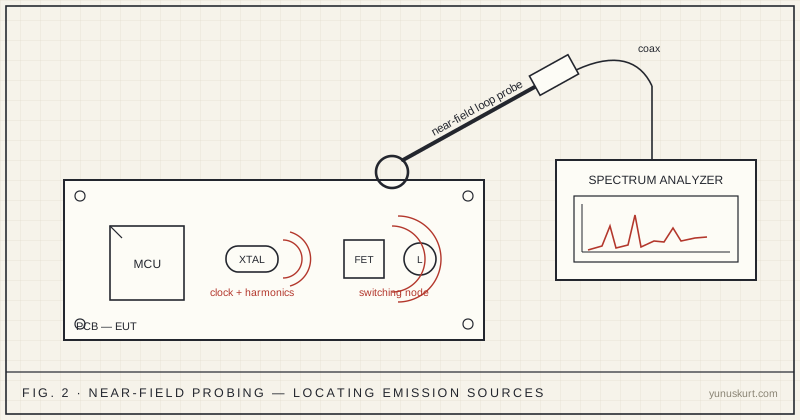 Figure 2 — Sweeping the board with a near-field loop probe. The clock circuit and the SMPS switching node are the usual hotspots.
2. Cable radiation. The device measures clean on its own — then the RS-485 or power cable is plugged in, acts as an antenna, and the limit is gone. Common-mode chokes at the cable entries and a low-impedance bond between the connector shell and chassis are critical.
3. The SMPS switching node. Minimizing the copper area of the switching node, adding a snubber, and placing the input filter close to its source cost you five minutes at layout time. Discovering them after the test costs you a board revision.
The shots the standard actually fires
Knowing the numbers before you book the lab keeps the day free of surprises. For industrial gear, the two immunity tests that fail the most designs are EFT/burst and ESD.
EFT/burst — IEC 61000-4-4
The generator fires 5/50 ns pulses grouped into 15 ms bursts, repeated every 300 ms, at a 5 kHz or — preferred in the current edition — 100 kHz repetition rate. Power ports are hit through a coupling/decoupling network; communication lines go through the capacitive clamp shown below. The link must be alive and exchanging data while the bursts run, at least one minute per level and polarity.
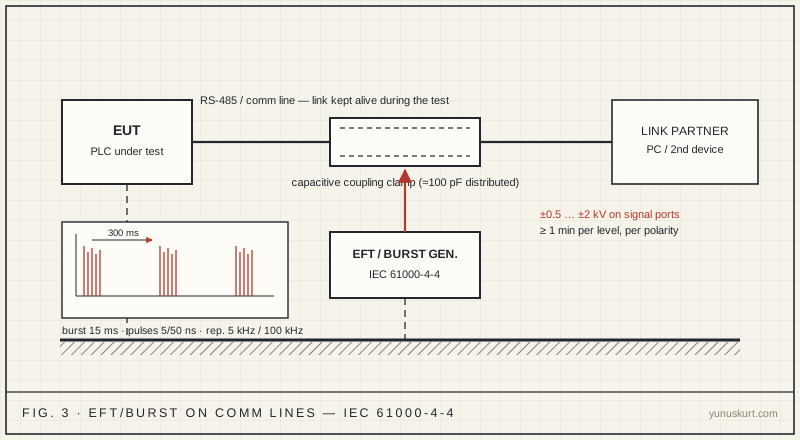 Figure 3 — EFT on the comm lines via the capacitive coupling clamp. The inset shows the burst structure: 15 ms packets of 5/50 ns pulses every 300 ms.
| Level | Power ports | Signal / comm ports | Typical environment |
|---|---|---|---|
| 1 | ±0.5 kV | ±0.25 kV | Protected (computer rooms) |
| 2 | ±1 kV | ±0.5 kV | Light industrial |
| 3 | ±2 kV | ±1 kV | Industrial — the usual PLC target |
| 4 | ±4 kV | ±2 kV | Harsh industrial, next to switchgear |
If your generator supports it, run both 5 kHz and 100 kHz: input filters that swallow 5 kHz bursts comfortably sometimes start leaking at 100 kHz.
ESD — IEC 61000-4-2
The gun is a model of a charged human holding a metal tool: 150 pF dumped through 330 Ω. Contact discharge is the preferred method, at ±2/4/6/8 kV (levels 1–4); air discharge — for insulating surfaces — goes up to ±2/4/8/15 kV.
Shooting a connector is its own little procedure:
- Metallic shell → contact discharge: press the sharp tip onto the shell and fire. 10 single discharges per polarity, at least 1 s apart.
- Insulating face → air discharge: switch to the rounded tip, approach as quickly as practical until the spark jumps, retract fully, repeat.
- Pins are normally excluded — unless they can be touched during normal use (a front-panel USB port: yes; a backplane connector: no).
- Add indirect discharges to the horizontal and vertical coupling planes (HCP/VCP) near the device — the “someone zapped the bench” case.
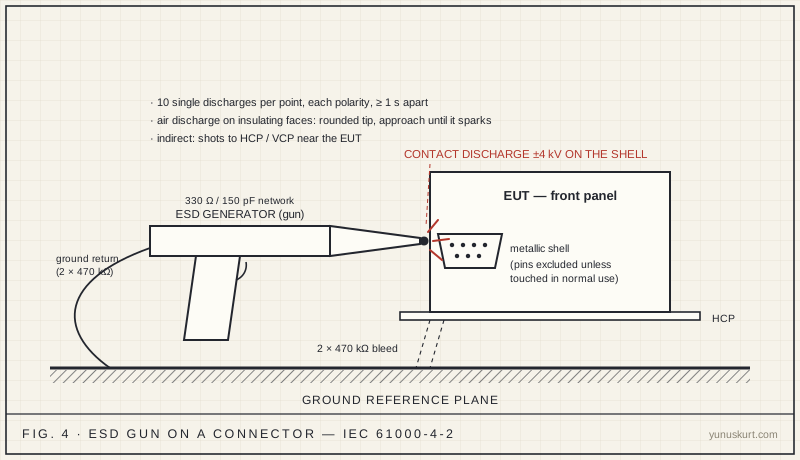 Figure 4 — Contact discharge on a metallic connector shell. Note the HCP under the device and the gun’s ground return strap.
Judge the outcome against the performance criteria: A — works right through it, B — disturbed but recovers by itself, C — needs operator intervention. For an industrial device, criterion B on communications and A on the control function is the usual target.
My pre-test checklist
- Set up the device exactly as it runs in the field: all cables connected, under a realistic load.
- Sweep the board with a near-field probe and note the three strongest sources.
- Check conducted emissions with the LISN — especially the 150 kHz–30 MHz band.
- Apply EFT to the communication lines. Does the device reset? Does the link recover on its own?
- Review the watchdog and communication-timeout behavior in firmware — in immunity tests, the device that recovers by itself is the device that passes the report.
These five steps raised our first-pass rate significantly. If you have questions or you’re stuck on your own bench setup, get in touch — I answer when I can.