Wireless: range, data rate, power — pick two
Every wireless link is a negotiation with physics, and the physics is blunt: you want long range, high data rate and low power, and you may have any two. A radio that reaches kilometres on a coin cell moves almost no data. One that streams video drinks current and barely leaves the room. Choosing a wireless technology is choosing which corner of that triangle your product lives in — everything else is detail.
Why you only get two
Three levers set the outcome. Range comes from link budget: more transmit power, a lower data rate (more energy per bit and a narrower, more sensitive receiver), or a lower frequency — sub-GHz signals travel further and punch through walls better than 2.4 GHz. Data rate costs bandwidth and signal-to-noise, which means more power or less range (Shannon doesn’t negotiate). Power is what’s left to trade. Push any one lever and at least one other gives.
So the map of wireless has a shape: cheap, low-power radios cluster at *short range
- modest rate* (BLE, Zigbee) or long range + tiny rate (LoRa). The top-right corner — long range and high rate — exists only with real power or a paid carrier behind it.
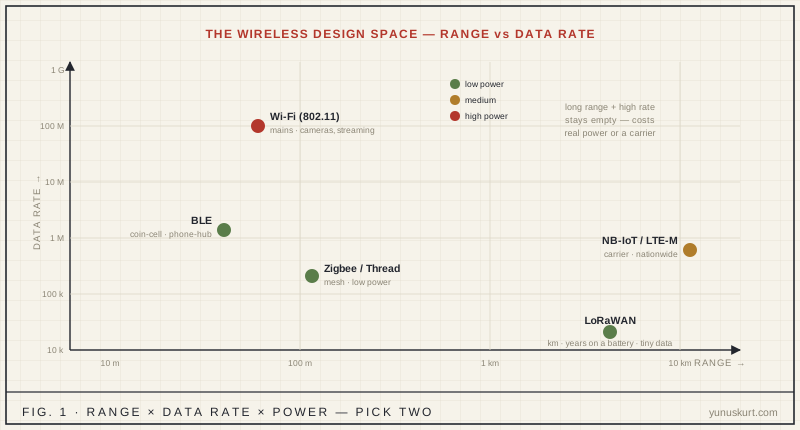 Figure 1 — The design space. Each technology claims a region; none reaches the long-range, high-rate corner cheaply. Read power as the third axis coming out of the page — the radios furthest right and lowest are the ones you can run for years on a battery.
The cast
| Technology | Band | Range | Data rate | Power | Topology |
|---|---|---|---|---|---|
| BLE | 2.4 GHz | 10–100 m | 0.1–2 Mbps | very low | star / mesh, phone-hub |
| Wi-Fi (802.11) | 2.4 / 5 / 6 GHz | 30–100 m | 10s Mbps – Gbps | high | star (access point) |
| Zigbee / Thread (802.15.4) | 2.4 GHz | 10–100 m / hop | 250 kbps | low | self-healing mesh |
| LoRaWAN | sub-GHz (868/915) | 2–15 km | 0.3–50 kbps | very low | star-of-stars |
| NB-IoT / LTE-M | licensed cellular | km, nationwide | 0.1–1 Mbps | low–medium | cellular |
Where each one wins — and doesn’t
BLE wins because the hub is already in everyone’s pocket: a phone pairs with it directly, no gateway to build. Coin-cell power and low cost make it the default for wearables, beacons, medical peripherals and phone-connected gadgets. It loses on range (a room, maybe a floor) and throughput, and it shares the crowded 2.4 GHz band with everything else.
Wi-Fi wins on raw throughput and the fact that it speaks IP straight to the internet — cameras, audio, firmware images, any device that moves real data and can afford it. It loses on power: association and a high-rate radio rule out a multi-year coin cell, so Wi-Fi wants mains or a fat battery. (802.11ah “HaLow” trades rate for sub-GHz range and lower power, but adoption is thin.)
Zigbee / Thread win on coverage through mesh: every mains-powered node repeats, so the network self-heals and reaches across a house at low power for the battery end-devices. Thread plus Matter is the home-automation backbone for lights, sensors and locks. They lose on throughput (250 kbps) and need a border router to reach the internet.
LoRaWAN wins where nothing else can go: kilometres of range on years of battery, on free spectrum with a gateway you own. It is the choice for farm, metering, asset and environmental sensors. The price is brutal data rate and latency — payloads of tens of bytes, sent seconds apart, capped by duty-cycle and airtime rules. Don’t design anything chatty, real-time, or OTA-heavy on it.
NB-IoT / LTE-M win when you need wide-area reach with no gateway to deploy — the carrier already covers the country. Trackers and smart-city nodes lean on them. The cost is a SIM and subscription, and more power than LoRa for the same idle sit.
The question that usually decides it
Before range or rate, ask what is the hub? Your phone → BLE. An access point you already run → Wi-Fi. A border router for a mesh → Thread/Zigbee. A gateway you deploy → LoRaWAN. The carrier’s network → cellular IoT. That single answer, crossed with your bandwidth and battery budget, picks the technology more often than any datasheet number.
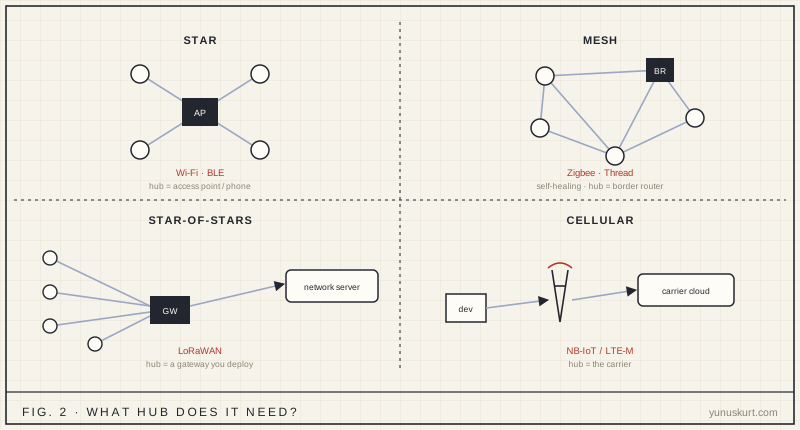 Figure 2 — Same question, four answers. The infrastructure a technology needs — a phone, an AP, a mesh router, a gateway, or a carrier — is often the real deciding factor, not the link itself.
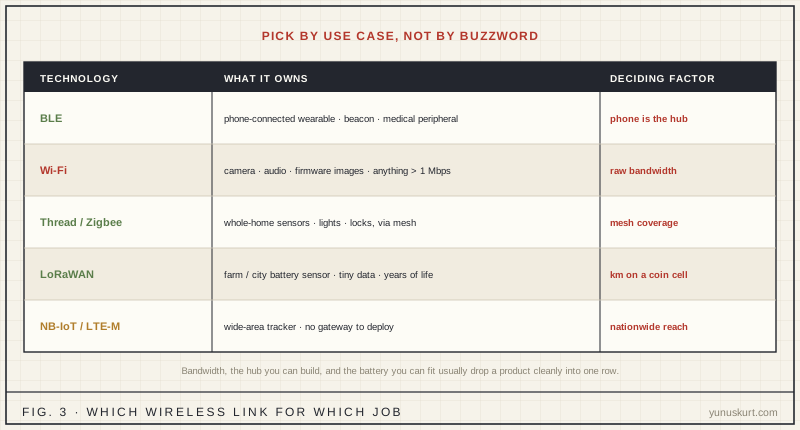 Figure 3 — Sort the use case, not the buzzword. Bandwidth, the hub you can build, and the battery you can fit usually drop a product cleanly into one bucket.
Field notes
- 2.4 GHz is a swamp. Wi-Fi, BLE, Zigbee and the microwave oven all share it; co-existence and channel planning matter. Sub-GHz (LoRa, 802.11ah, some Thread) is calmer and travels further for the same power.
- Halve the datasheet range, at least. Quoted figures are line-of-sight ideal; walls, human bodies and 2.4 GHz absorption cut them hard. Budget a fraction.
- Mind LoRa’s airtime. Duty-cycle and regional limits cap how often you may transmit — a chatty protocol or a firmware update over LoRa will hit a wall.
- Energy per message, not peak current. A fast radio used briefly often beats a slow radio used long. Measure the joules to deliver one packet, including wake, associate and retry.
- Count the hidden hub cost. “No carrier fee” LoRa still needs a gateway; “no gateway” cellular still needs a SIM and a subscription. Neither is free.