The microcontrollers that won — and why
Open any distributor’s catalog and you’ll find thousands of microcontrollers. Yet walk through real products — an espresso machine, a drone, a factory I/O module, a fitness band — and you keep meeting the same handful of parts. That isn’t an accident, and it isn’t because those chips have the best datasheet numbers. MCU adoption is decided by everything around the silicon, not the silicon itself. This post is about which chips won and the forces that put them there.
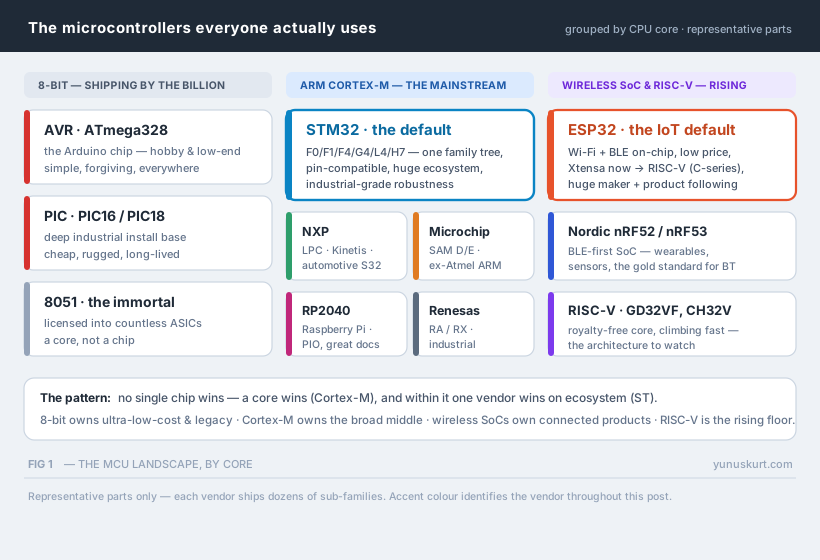 Figure 1 — No single chip wins. A core wins (ARM Cortex-M), and within it one vendor wins on ecosystem (ST). 8-bit holds the ultra-cheap floor; wireless SoCs own connected products; RISC-V is the rising base.
First, a core won
Before any single vendor won, an architecture did. In the 2000s every manufacturer had its own incompatible 8/16-bit core — switch vendors and you threw away your compiler, your debugger and your muscle memory. ARM changed the model: it doesn’t make chips, it licenses the Cortex-M core to everyone. ST, NXP, Microchip, Nordic, Renesas, Raspberry Pi all build silicon around the same CPU.
The consequence is enormous. One toolchain (GCC + CMSIS) compiles for all of them. A driver written for one is structurally familiar on the next. Knowledge, libraries and an RTOS port made for Cortex-M apply across a dozen brands. The core became a commodity standard — and standards are where ecosystems grow. (8-bit survived underneath it on price and simplicity; AVR and PIC still ship in the billions for jobs that don’t need 32 bits, and the 8051 lives on as a licensed block inside countless ASICs.)
Today RISC-V is doing to ARM what ARM did to the proprietary cores: a royalty-free ISA that GigaDevice, WCH and Espressif are already shipping. It’s the floor rising again — worth watching, not yet the safe default.
Why a chip wins: the flywheel
Here is the part newcomers underestimate. Given two MCUs with identical specs, the one with the better ecosystem wins every time — and that advantage compounds.
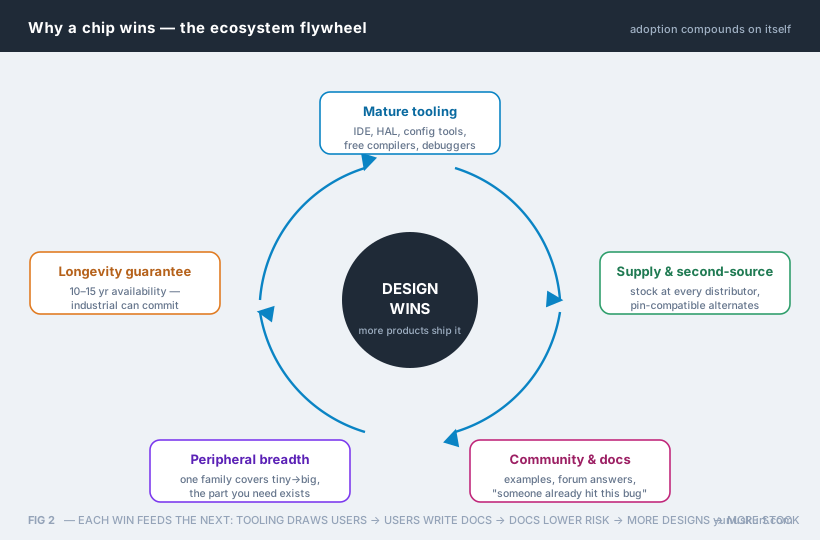 Figure 2 — Adoption compounds. Good tooling draws engineers; engineers write examples and forum answers; those lower the risk of the next project picking it; more designs mean more stock and more second-sources — which draws more engineers.
Each spoke is a real decision factor:
- Tooling. A free IDE, a graphical pin/clock configurator, a HAL, a $5 debugger. The cost of starting is what kills most chips.
- Availability & second-sourcing. Can you buy 10k of them next quarter? Is there a pin-compatible alternate if one factory hiccups? The 2021 shortage burned this lesson into every purchasing department.
- Community & documentation. When you hit a weird I2C lock-up at 2 a.m., somebody has already hit it and posted the fix. That archive is a feature.
- Peripheral breadth. One family that spans a 48 MHz value part to a 550 MHz monster means the part you need almost certainly exists — without leaving the ecosystem.
- Longevity. Industrial and automotive customers need a 10–15 year build guarantee. A vendor that promises it unlocks a market that simply won’t touch a chip that might vanish in three years.
The STM32 case study
STM32 is the clearest winner of this game, and it’s worth seeing why concretely — because it’s the same recipe the other winners followed in their niches.
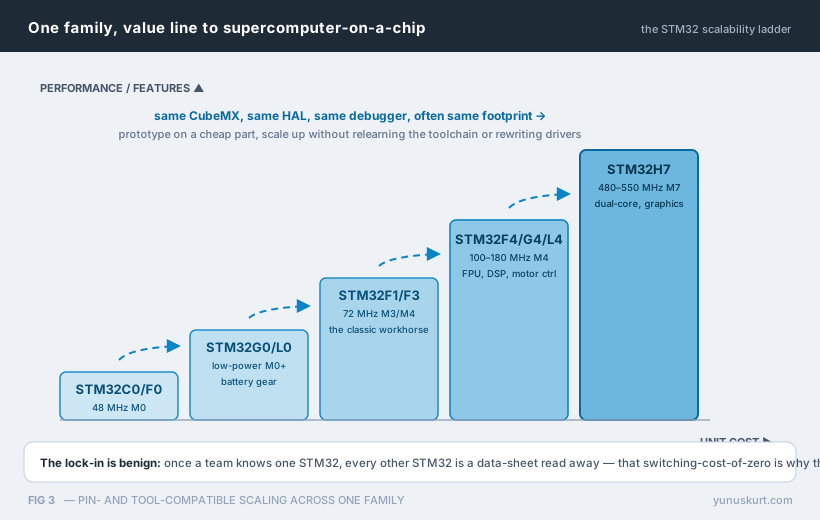 Figure 3 — The portfolio ladder. Prototype on a cheap M0, scale to an H7, and reuse the same CubeMX project, HAL and debugger. The switching cost between rungs is near zero — which is exactly why teams stay.
What ST actually did right:
- One family tree, pin-compatible. Outgrow a part and the upgrade is often the same footprint with more flash — and always the same tools. That ladder (Figure 3) makes the whole portfolio sticky.
- A complete, free toolchain. CubeMX generates init code from a clickable pin map; the HAL/LL libraries cover the peripherals; STM32CubeIDE is free; the ST-Link debugger costs a few dollars and is built onto every Nucleo/Discovery board. Starting an STM32 project on a Friday night costs nothing.
- A massive community. Two decades of forum posts, libraries, Arduino-core support, and every hobby project on the internet. Risk-reduction by archive.
- Industrial-grade robustness. This is the part hobby comparisons miss. ST characterizes ESD and EMC behavior in the datasheet, offers wide industrial/automotive temperature grades, ships IEC 60730 / 60335 Class-B self-test libraries and functional-safety (SIL) packages. For anyone building a product that has to pass certification and survive a factory floor, that documented robustness is worth more than a faster clock. (If you’ve fought an EMC pre-compliance bench, you know why this sells.)
- Longevity commitments. A 10+ year availability program lets an industrial customer design it in and forget about it.
Specs didn’t win this. The surroundings did.
The other winners, and their one reason
Every other popular MCU won the same way — by owning one spoke of that flywheel hard:
- AVR / Arduino (ATmega328). Won on the lowest possible barrier to entry. The Arduino abstraction made an 8-bit chip the world’s teaching platform; that install base still pulls it into products.
- ESP32 (Espressif). Won on integrated wireless at a shocking price. Wi-Fi + BLE on a sub-$3 module collapsed the cost of a connected product. It’s the default the moment a project says “and it talks to a phone.” (Its newer C-series quietly moved to a RISC-V core.)
- Nordic nRF52/nRF53. Won on being the best at Bluetooth Low Energy — a clean, reliable BLE stack and superb power numbers made it the gold standard for wearables and sensors.
- RP2040 (Raspberry Pi). Won on price, documentation and PIO — a brilliantly written datasheet and the programmable-I/O block earned it a following overnight.
- PIC / NXP / Renesas. Won on legacy and qualification — deep industrial and automotive install bases, AEC-Q100 parts, and the longevity guarantees that conservative markets demand.
When not to follow the crowd
Following the herd is usually right — you inherit the whole flywheel — but not always:
- Cost floor. At millions of units, a 30-cent 8-bit part beats a $1 Cortex-M. Penny-counting overrides ecosystem.
- A peripheral nobody else has. Sometimes one vendor has the exact analog front-end, radio or motor-control timer you need, and that trumps familiarity.
- Single-source risk. The flip side of a popular part is everyone competing for the same stock. The shortage taught teams to design with a second source in mind from day one.
- You don’t even need the MCU you picked. Half the “which chip” arguments dissolve once you ask whether the firmware needs an RTOS at all — architecture choices upstream change the requirement.
Field notes
- Pick the ecosystem before the part. Choose the family first (toolchain, HAL, debugger, community), then drop into the specific part. Re-learning a toolchain costs more than any per-unit price delta on a low-volume product.
- Second-source on paper before you tape out. Note the pin-compatible alternate in the schematic title block now, not during the next shortage.
- For anything that ships to a customer, read the EMC/ESD section of the datasheet, not just the GPIO count. Robustness is a spec.
- A dev board you can buy today beats a better chip you can’t. Momentum is a feature; treat it like one.
- Watch RISC-V, don’t bet the product on it yet — unless royalty-free silicon or full toolchain control is the actual goal.